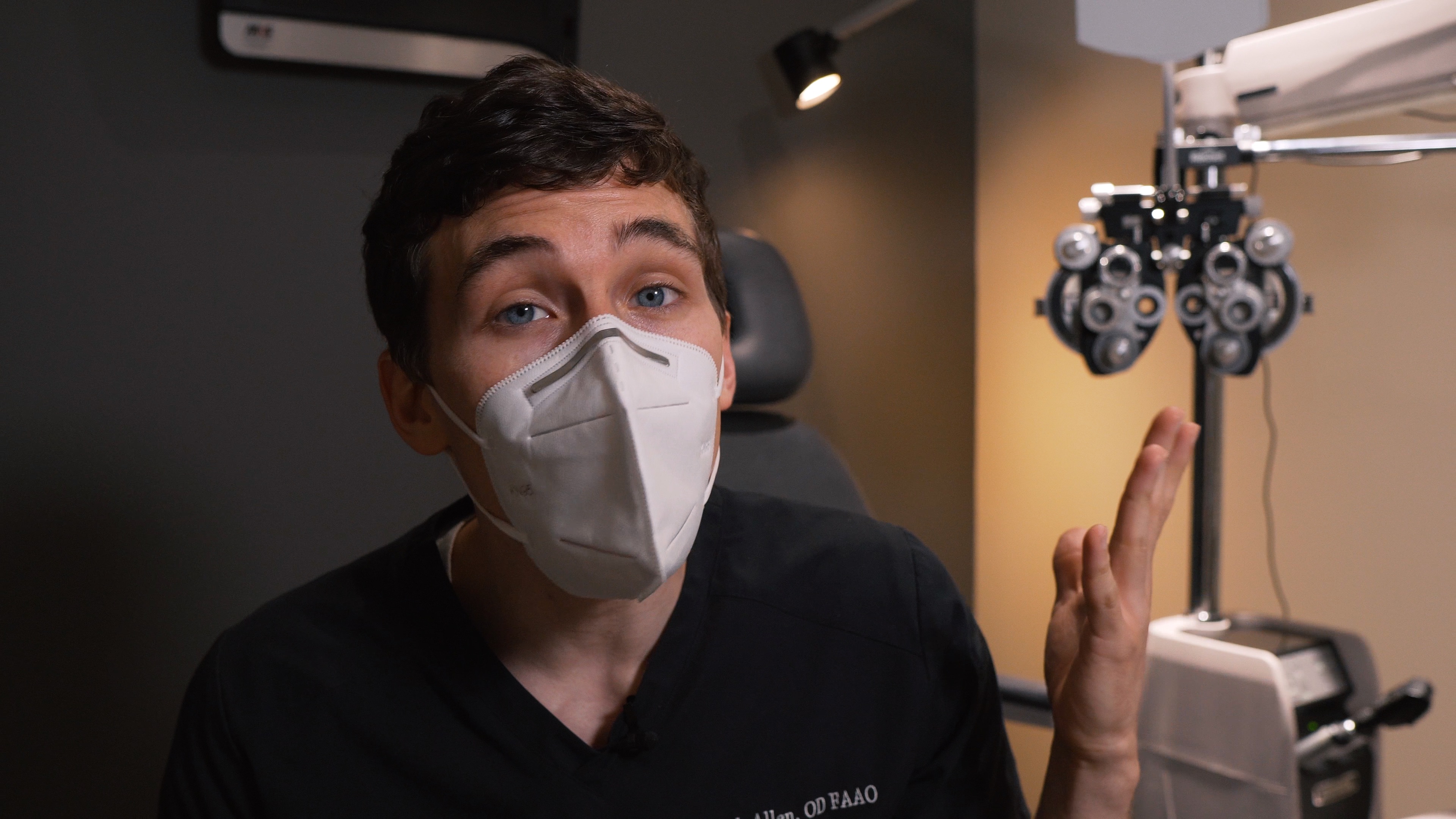
Imagine this: “You have a new patient on your schedule who has a red eye. It is painful, they’re light sensitive, their vision is blurry, and they just slept in their contact lenses!” This probably isn’t so hard to imagine. To see whether you’d handle this patient the same way Dr. Allen would, watch this latest episode of “Eye Care Insiders”.
Financial disclosure: Alcon, Amazon, Bausch + Lomb, Harrow, MYZE, Nanodropper. (Dr. Joseph Allen, OD, FAAO, Dipl ABO)
Joseph Allen (00:00):
Okay, so you're in your clinic and you have a new patient on your schedule who has a red eye. It is painful. They're light sensitive, their vision's blurry, and they just slept in their contact lenses. So, your top differential is you're worried they might have an infected corneal ulcer, perhaps acanthamoeba, or maybe just an abrasion, something going wrong with the eye or maybe herpes because when in doubt, it's always herpes. Or could it just be CLARE, “Contact Lens-induced Acute Red Eye”? So today we're going to break down what CLARE is, some differentials to be considering, and of course, how to treat it and what to do to help your patients hopefully never get it again. Let's take a look.
(00:50):
Okay, so first, what exactly is CLARE? Again, it stands for “Contact Lens-induced Acute Red Eye”, or sometimes I've even heard it referred to as “Contact Lens-Associated Red Eye”. Either way, the names are kind of nondescript, but basically refer to a non-infectious inflammation that's occurring on the ocular surface due to a contact lens. Most common in my experience are people who either sleep in their contact lens or overwear them in some way, right? Those patients who extend their contact lens wear to maybe beyond its wear use, stretching it to way beyond a month, closer to two months or more. However, in case you haven't checked the literature, whether somebody's wearing a biweekly lens like a two-week lens or a monthly lens, on average, most people do change those out and replace them at about six weeks. Some people also will get it with a tight fitting contact lens because fundamentally why somebody's having this level of inflammation, whether it be on the conjunctiva, the cornea, is because there isn't enough tear exchange, there's not enough oxygen getting to the ocular surface or certain bacteria, metabolites, toxins from bacteria sitting on the eye stuck underneath that contact lens that's causing irritation and the body is having that inflammatory reaction from it.
(02:20):
And because of all this, common signs that we often see are not only corneal edema, but conjunctival redness. We'll see SPK, epithelial defects, neovascularization, as well as sterile corneal infiltrates. Some of the biggest parts to making an accurate diagnosis of what is going on in this sort of case is to not only evaluate the ocular surface, but also have a really good history. Did you sleep in your contacts last night or have you showered in them, gone swimming in them, hot tubbing in them? How often do you replace these lenses? Do you end up stretching them out quite a bit? And then of course there are other questions you can expand on like what type of solution do they use? Have they changed to a different brand of solution recently? How often do they clean their case? Do they clean their case? Or when is the last time they changed out their contact lens case?
(03:11):
And not too surprisingly, a lot of your patients probably have not changed their contact lens case since the last time you gave them one. But either way, one of the biggest things you're going to need to do is stain that cornea, numb it up, take a look, see if there's an ulcer. And if that ocular surface looks like it has an ulcer, whether it be infectious or not, boom, I hit that with a broad spectrum antibiotic. Honestly, for me, even if somebody has a small epithelial defect and they are a contact lens wearer, especially with suspicious signs of contact lens abuse, then I just want to be covered. Now in the event of true CLARE, usually I see this on the top one third of the cornea, right where everything sits underneath that top eyelid. So I do ask the patients to look down, I lift that upper eyelid.
(03:59):
You may see something like a sterile corneal infiltrate. There's no epi defect overlying it. Similar to finding corneal neovascularization going on, same thing, someone's overwearing their contacts. In these cases, if there's no epi defect, they usually respond excellent to topical steroids. And if the epithelium is truly 100% intact, then I don't think there would be anything wrong with just going with a short course of topical steroids. But I will say that if I have a patient where I'm suspicious of them abusing their contact lenses, they have a history of sleeping in them, perhaps they have other signs of bad blepharitis or something, I honestly have no issue combining it with an antibiotic just to have that extra coverage. But don't also forget to assess for other possible things too. I learned this from mentoring several students for a few years in their fourth year. Use a CTA, a contact applicator, flip that upper eyelid or whatever method you like to use.
(04:56):
Also assess for tight fitting contact lenses or perhaps some level of corneal warpage, especially if their vision seems off than where it was before. Either way, when patients have complications from contact lenses, best practice to have patients not wear their contact lenses until things are fully resolved. Fingers crossed, they have a backup pair of glasses. Otherwise, I think it's also a good idea to consider switching lens material modality or the fit in some cases, especially if there's other signs. If they have corneal neovascularization, switching to a higher Dk/t material may be a better choice. If a patient has GPC, switching to a single use daily lens is probably going to be a better choice as well. Also reeducating patients about hand hygiene, case hygiene, even eyelid hygiene is a good choice. And I always document that we had a discussion about water, about not showering, not swimming, not hot tubbing in lenses, and even not sleeping in lenses, even for the lenses that are technically FDA approved for a time to sleep in lenses.
(06:01):
I personally, just from reading the research and in my experience, those are the highest risk cases, the much greater chance of seeing complications. For those patients who love to sleep in their contact lenses, you know what? I have a refractive surgeon friend who I think they should have a consult with. Now, of course, there can be other differentials or things to think about. Even if a patient hasn't been abusing their lenses, one of which is perhaps they just switched to a different contact lens cleaning solution. In my experience, this is often a patient switching from a branded solution that we are more aware of and trying a generic or kind of an off brand that they found at the store. Sometimes people will just have an allergic response to some of the preservatives or other ingredients. Then of course, going back to the question about swimming, hot tubbing, always concerned about acanthamoeba, but not a bad idea to stay open-minded about other possible differentials for just any generic red eye.
(07:02):
Just because they slept in their lens doesn't mean that they don't have just a generic bacterial or viral conjunctivitis. It doesn't mean they don't have EKC or perhaps herpes simplex keratitis. You can still get those even though you are a contact lens wearer. So always evaluate that ocular surface carefully and stay open-minded, especially when things aren't adding up. Consider checking for lymphadenopathy, look for different clinical signs, check for corneal dendrite, make sure that they don't have a canaliculitis. That is when the clinical investigator hat really gets put on. And honestly, I think is where eye care gets really fun. Now my kind of bonus clinical question for you is that when you have a red eye in the clinic, do you put gloves on for that evaluation? Personally, even before 20/20, yeah, if there's a red eye possibly infectious, I love to put gloves on.
(07:56):
In fact, I keep a mental note of absolutely everything I touched in the clinic, whether it be my pens, tools, handles. And once the patient leaves, I wash down the light switches, everything the patient possibly touched, even cleaning off every piece of the slit lamp, again, countertop, pens, dials, everything. Even going back to cleaning my keyboard, mouse in the other rooms. But again, maybe I'm just being a germophobe. I remember taking microbiology in college and it stuck with me, but let me know your thoughts. And now I think the final thing I'll end on is some extra tips, things that I've thought of. So right here in our clinic, in this exact exam room, it's just kind of a bare wall. Now we could put a lot of different things there. We could put pictures of eyeballs or all sorts of different stuff or my degrees, diplomas.
(08:45):
What I honestly wish we had here was framed PubMed articles about contact lens-related infection, ulcer habits, because then anytime a patient asks me about why I am fitting them in a single use daily lens, et cetera, et cetera, I can point to that article or series of articles and explain to them because we know the chance of infection is way less and that is something we value in taking care of our patients and that emphasizes why we have those prescribing practices, right? A lot of our patients do see things online. They see the price of online sale contact lenses, and they think that we're up selling them, up charging them in some way. But no, we are following our values and how we best take care of our patients and you can always point to that there. So that's just something I've thought of and fits well with why and how I practice.
(09:43):
And again, same thing, love your thoughts and feedback. If you think that's a good idea, if you do something similar or just let me know your thoughts about all of that. Otherwise, thanks so much for being here. Hopefully you don't run into too much CLARE in the next week. Keep an eye on it and we'll see you in the next video. Peace.


























_1701789080.png?auto=compress,format&w=180)







.mp4.00_05_41_04.Still001_1680887186.jpg?auto=compress,format&w=180)

.00_13_09_19.Still001_1676069079.jpg?auto=compress,format&w=180)



































Please log in to leave a comment.