


Search
Search
EURETINA: 2026

Show Description +
Dr. Zweifel explores the longer durability provided by faricimab (Vabysmo, Genentech/Roche) and aflibercept 8 mg (Eylea HD, Regeneron) for wet AMD, as well as the utility of fluid volume analysis.
Posted: 10/07/2026
Dr. Zweifel explores the longer durability provided by faricimab (Vabysmo, Genentech/Roche) and aflibercept 8 mg (Eylea HD, Regeneron) for wet AMD, as well as the utility of fluid volume analysis.
Posted: 10/07/2026
Read Transcript
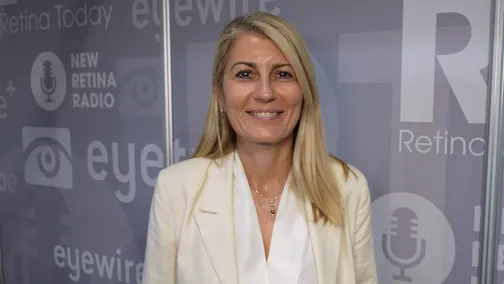
Hello everyone. My name is Sandrine Zweifel and I'm a professor at the University of Zurich and I'm head of the medical retina department at University Hospital in Zurich. I'm also a member of the Euretina AMD CSC subspecialty program. And I talked this year at Euretina in the neovascular AMD session about the two new second generation anti-VEGF drugs. So we have learned from the pivotal trial and also from the real world data that these two agents work quite well. They reduce the number of injections. You can increase the treatment interval and reduce the burden of visits for the doctors, but also for the patients. So this is great news for the patient. There is also a high safety profile, so it's safe to use these new agents. What about when you use second generation analysis? What tells us this analysis from real world data? For this, we looked at data from the Swiss Retina Research Network, which is a Swiss collaborative project involving public, private, and also academic centers.
And we looked at around 450 patients, treatment naïve and switch neovascular AMD patients who were treated with either faricimab or high dose aflibercept. And we looked at the first visit after the first injection of high dose aflibercept or faricimab, and then we followed them up to 12 months. We looked at the fluid volumes and what we could see was actually quite impressive. We saw a reduction of fluid volume for both for intra and subretinal fluid from around 80 to up to 99% in the treatment naïve patients. Of course, for the switch cases, we also saw a reduction in fluid volume in nanoliters, but this was a less marked reduction than in the treatment naïve. And of course this is expected. But what about the relationship from central subfield thickness to volume data? We looked at around 1,340 OCT scans and we could show that the central subfield thickness actually only explains the variation in fluid volume in about 30% of the cases.
So I think it's good to know for us as clinician and also for the patients that we now have newer treatment options available. We have these two molecules, second generation, which show a high efficacy and also a high safety profile. And we also see that there is a paradigm shift in how we analyze our real world data, focusing more on fluid volume, which gives you also another perspective. Thank you for having me.
Bryn Mawr Communications, LLC, and Eyetube.net are not affiliated with the official program of EURETINA: 2026.









Please log in to leave a comment.