


Search
Search
VBS: 2026

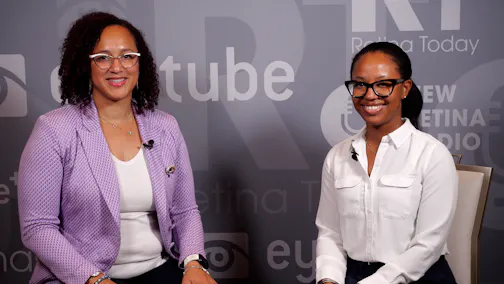
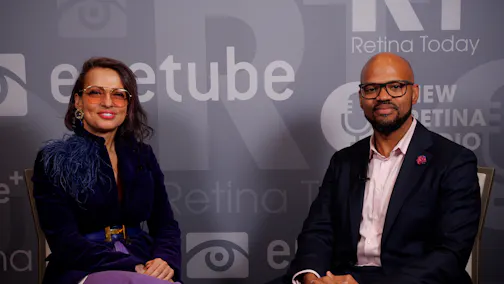
Michelle Liang, MD and Jordan D. Deaner, MD
Show Description +
Drs. Deaner and Liang share approaches to scenarios that may arise for attendings while guiding fellows in vitreoretinal surgery, such as a fellow who is anxious about operating or makes a mistake, and the best ways to offer feedback.
Posted: 4/22/2026
Michelle Liang, MD and Jordan D. Deaner, MD
Drs. Deaner and Liang share approaches to scenarios that may arise for attendings while guiding fellows in vitreoretinal surgery, such as a fellow who is anxious about operating or makes a mistake, and the best ways to offer feedback.
Posted: 4/22/2026
Read Transcript
Jordan D. Deaner, MD (00:17):
Hi everyone. I'm Jordan Deener. I'm here with Michelle Liang. We just finished up session number three at Vit-Buckle Society 2026. We were teaching vitreoretinal surgery and how it's a balancing act. Michelle, nice to be with you.
Michelle Liang, MD (00:32):
Thanks so much for having me.
Jordan D. Deaner, MD (00:33):
Absolutely. I'd like to rehash. We went over a few scenarios during our session. The first one was dealing with the anxious fellow. And so how do you approach the fellow that comes into the OR, clearly high energy, they come and they get into the eye and maybe they have a tremor. How do you approach that fellow?
Michelle Liang, MD (00:53):
Yeah, I think it's a pretty common thing, especially as we are teaching fellows that are new, specifically to retina surgery. So they're excited to do the case and once they get started, if they're having fine detail, it's possible that a tremor could develop, especially during a membrane peel.
(01:11):
So when this happens, there's a few things to look at. One, I'm looking at the fellow and how they're sitting and how they're holding their instruments and just looking to see if they're comfortable in the chair.
(01:22):
So I think it's a pretty common thing to have a fellow be anxious. So if I see that a fellow is starting to get nervous and might have a tremor, oftentimes I'll see where their hands are at the head of the bed and see how they're sitting just to make sure they're comfortable.
(01:39):
And then there's a few things just when they're operating just to maximize their efficiency when they're doing the surgery.
Jordan D. Deaner, MD (01:49):
Do you have a fellow, do you ever have them stop in the middle case, shake it out, do some stretches? Do you ever suggest maybe hitting the simulator a little bit to get out that angst?
Michelle Liang, MD (02:00):
So I think during the time of the surgery, if you're seeing it, oftentimes I will have the fellow come out of the eye, relax their fingers a little bit, sometimes just put the instruments down.
(02:10):
And then when they go back into the eye, just make sure they're in good position. Sometimes making sure that their hand is on either the patient's forehead or sometimes their wrist rest, just so they have something to study themself on.
(02:21):
There are a few things preoperatively you could consider if you know that this fellow might have that predisposition. So as far as potentially maybe skipping a caffeine that morning, maybe not doing a hard workout before the surgery.
(02:36):
I think we've talked a little bit about if someone's really nervous, is there a role for medication? And there might be other tactics to avoid that, but there are all certain things to consider when teaching fellows.
Jordan D. Deaner, MD (02:47):
I think that was a wonderful summary. I think we moved from the nervous fellow, then we went on to the fellow that was making an error in the surgery. And so in particular, the fellow had dinged the optic nerve and then went on to pinch the retina a few times, make a few defects in the macula.
(03:07):
How do you manage this fellow that makes a mistake and they're shook up a little bit, maybe you're shook up a little bit too while you're watching them. What's your next step?
Michelle Liang, MD (03:18):
So mistakes happen and I think they happen to fellows, they happen to us and we all have to deal with that. And so if I'm helping a fellow and something happens, my first response is to make sure that they've also noticed that it happens.
(03:32):
Because sometimes they might be just so focused on one of the things that they're doing, they don't realize that maybe something else happens somewhere in the eye. So just taking a step back to look at what happened and seeing how we go forward.
(03:44):
If the fellow seems like they're still able to proceed with the case, I will let them. And I think that there are certain points where maybe something has happened and they don't have that confidence anymore to move forward.
(03:57):
There might be a role to switch places, but I think that every fellow is different and you can gauge that during the case.
Jordan D. Deaner, MD (04:05):
I loved what you said during our session. Sometimes we need to switch. The fellow gets nervous. I think especially when a fellow who didn't have a tremor develops a tremor after a mistake, that's a warning sign.
(04:17):
So we need to switch, but you made a great point of sometimes switching back. So once you've got the situation maintained, letting the fellow finish the case, I think that really does help their confidence and helps their ego.
(04:28):
We talked a little bit about making sure they don't get ego damage or confidence damage. Have you ever seen a fellow make a significant error and then regress a little bit in their learning or become very hesitant in the eye?
Michelle Liang, MD (04:41):
Yeah, I think that's pretty common. And probably the same thing would happen for us. If we have a big complication, we'd be extra careful the next time.
(04:48):
I think that, especially for peeling membranes, if we have a fellow that goes really deep, I'm sure their next few are going to be very superficial and I think it's easy to overcompensate.
(04:58):
But I think that's why it's good to regroup and then still let them do it again afterwards, just to let them know that they can overcome that and they can continue to work on their progress.
Jordan D. Deaner, MD (05:09):
I think the last thing I'd like to touch on is just the idea of giving feedback. And so the fellow had made a few errors in the eye. So when do you give feedback? Do you give feedback? Stop in the middle of the surgery and give feedback. Do you give feedback between cases? Do you do it at the end of the day? And then what is your feedback like?
Michelle Liang, MD (05:29):
So I definitely give feedback at probably a couple points. I think real time, if something is happening that needs to be addressed, I definitely want to bring it up to the fellow just to make sure that we're on the same page, that we prevent further issues going forward.
(05:42):
But I definitely try to be calm during it. You don't want to raise any alarm for either the patient or the fellow or yourself. And so just doing that in a calm but confident manner.
(05:52):
And then after the case, if there are issues that develop or often even if there's not, I'll go to the fellow and just say, how do you think that case went? Is there something that you think maybe we could have done better, maybe that you wish you did differently?
(06:05):
I think that if we do it at the end of the day, sometimes it's just you've had so many cases, you might be tired, you might forget some of the smaller nuanced things. So I like to do it a little bit closer to the time of the surgery.
Jordan D. Deaner, MD (06:16):
Well, Michelle, thank you and thank you for an excellent panel today.
Michelle Liang, MD (06:19):
Thanks so much for having me.
Bryn Mawr Communications, LLC, and Eyetube.net are not affiliated with the official program of VBS: 2026.











Please log in to leave a comment.