


Search
Search
VBS: 2026

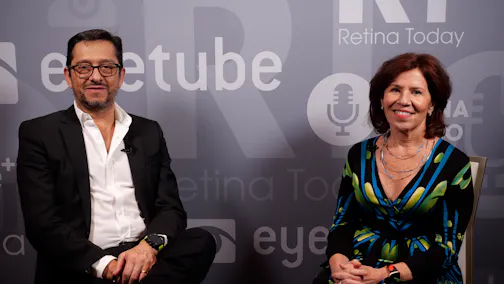
Dimitra Skondra, MD, PhD, FASRS and Matthew A. Cunningham, MD
Show Description +
Dr. Cunningham asks Dr. Skondra to highlight some key pearls for handling challenging diabetic surgery cases, such as managing iatrogenic breaks when they happen.
Posted: 4/22/2026
Dimitra Skondra, MD, PhD, FASRS and Matthew A. Cunningham, MD
Dr. Cunningham asks Dr. Skondra to highlight some key pearls for handling challenging diabetic surgery cases, such as managing iatrogenic breaks when they happen.
Posted: 4/22/2026
Read Transcript
Matthew A. Cunningham, MD (00:17):
Hi, my name is Dr. Matthew Cunningham, and I have the pleasure to be discussing with Dr. Dimitra Skondra her talk today on challenges with diabetic tractional detachments. How are you?
Dimitra Skondra, MD, PhD, FASRS (00:31):
I'm good. Thank you for having me here. It's great. I look forward to our chat.
Matthew A. Cunningham, MD (00:36):
Absolutely, absolutely. So you gave a very salient discussion today on diabetic tractional detachments, which we in Orlando take care of a lot of these. You obviously trained and did a lot of your work in Chicago. Tell me about the diabetic patients that you saw there.
Dimitra Skondra, MD, PhD, FASRS (00:51):
Well, as I said in my talk, this is not textbook tips. It's things that I discovered on the battleground by doing gnarliest and most complicated diabetic population in the South Side of Chicago and the public system there.
(01:06):
And the lesson learned for this is that it's really tough cases and it's not for those that are easy on the heart. We're all mad, but we chose to do them and we make the choice. And it's really a wonderland that will put you in trouble if you take it seriously, and really approach every case with a critical eye.
Matthew A. Cunningham, MD (01:28):
And one thing that stuck with me was every one of these cases is different, every patient is different. When you're approaching these cases that sometimes they have more fibrosis or more vitreous hemorrhage, is your approach the same, like when you're preoperative planning? I know you talked about maybe even doing B-scans, doing an OCT beforehand to kind of get the planes right. What are your steps when you're thinking about these cases?
Dimitra Skondra, MD, PhD, FASRS (01:54):
So the basic steps are the same. So in every patient, I start thinking about how I want to process surgically once I decide to do surgery regarding, number one, do I need to take care of the lens before I go in or it's okay to go ahead? And I always tell the fellows that ... The fellows always focus on the retina and then I'll ask them, "How does the lens look?" and they're like, "Uh..."
(02:15):
For me, I know I can fix the retina, but if I cannot see, I cannot fix the retina. So these are some very standard, and I don't approach everybody the same in the sense not everybody gets cataract surgery before, not everybody gets lensectomy, but I decide based on each patient.
(02:29):
But the principles are always the same, I look at the lens, then I look at the retina. If there's vitreous hemorrhage, you'd obviously do a B-scan. I look at the systemic health. I start the clearance process. Every diabetic patient of mine gets a medical clearance, even those that look healthy because you never know in these patients. And also, I want to make sure they're stable. Because I really like pre-op Avastin. So I always do pre-op Avastin, but I always make sure I have the clearance before I do so.
(02:55):
And the day they come, we check vitals and ask them how their blood pressure, they're doing well. If they have any concern that they're having an infection, then I don't do the injection and I reevaluate them. Unless it's an emergency, which is most of the case is not. I mean, I know people are scared, "Oh, what if the fovea comes off?" But to my experience, even if the traction gets a little worse in the matter of a few days, I don't think it affects the final outcome more. And actually, it makes your outcome better because you have less bleeding and it's easier to control the fibrosis and [inaudible 00:03:27]
Matthew A. Cunningham, MD (03:27):
I actually, the one thing that I did gain from your talk was the fact that you get this clearance before you administer the Avastin. I've been burned before by giving intravitreal Avastin beforehand, all for them to get canceled the day of surgery.
Dimitra Skondra, MD, PhD, FASRS (03:43):
This is a risk that you cannot avoid because it's a diabetic patient and they may come the day of the surgery and the sugar is very high. But because I have the clearance and acute event, at least you know that you still have some time, and that's why I give it two to four days. So even if there is a delay, I still have the whole one week to 10 days.
(03:59):
So I don't give it a week so that if it's delayed, then you're really going to therapy, already taking longer without being treated. So I buy myself time because it works very fast. You can do the injection on Monday afternoon and they come on Wednesday for surgery in the morning and it's already controlled. So I don't do it too far away because I want the little safety time if that that day they have an issue, can't have the surgery, I still have another almost a week to address it still being within the safe period.
Matthew A. Cunningham, MD (04:24):
The other thing that I really thought was fantastic was that you actually brought about the fact that iatrogenic breaks happen. And when they happen, not to panic. Do you want to comment on that at all? I think that was an extremely important point for-
Dimitra Skondra, MD, PhD, FASRS (04:38):
Absolutely. I mean, we should always try to avoid them, but I think that... And that's why I said it's about control and not speed. I mean, we always live in an area, want to finish surgery soon. But especially in diabetic cases, if you get a bed, especially early on in the case, and then the retina becomes more mobile, then you're making your job much harder and then we end up taking much longer.
(05:00):
So it's a fine balance between be efficient, but not taking too much risk and jeopardizing the break, especially on the case. But it will happen, that's unquestionable. And actually can have still an excellent outcome if you have a break. You just need to not panic, breathe, and know what to do, and know that what is important to achieve once you have a break. You have to really relieve the traction.
Matthew A. Cunningham, MD (05:24):
Traction. Correct.
Dimitra Skondra, MD, PhD, FASRS (05:24):
But if you don't relieve the traction, personally, I found it's okay to do a little focal retinectomy. Or it's okay to leave a little tuft or font as long as it's really separated from other fonts nearby and there's no hyaloid connecting them. So I have cases, I had a break next to a tiny font as I was trying to segment it. And it was next to the big vessels so I didn't want to do a focal retinectomy, but I make sure it was disconnected and lazered around the little font. So there was no traction. There was still a little plug, but there was no traction and it was okay.
Matthew A. Cunningham, MD (05:55):
Well, that's fantastic. Honestly, I think these are pearls. And I thank you for sharing all these pearls with everybody. And thank you for a fantastic talk during this session at Vit-Buckle Society here in Las Vegas. Thank you guys for tuning in.
Dimitra Skondra, MD, PhD, FASRS (06:10):
Thank you.
Bryn Mawr Communications, LLC, and Eyetube.net are not affiliated with the official program of VBS: 2026.















Please log in to leave a comment.