


Search
Search
ARDS: 2026

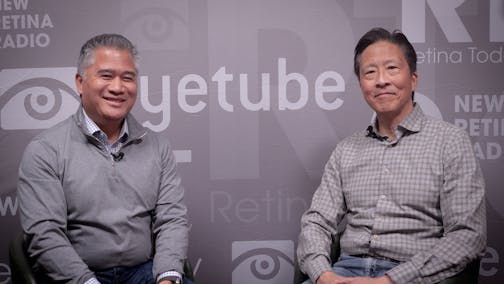
R.V. Paul Chan, MD, MSC, MBA, FACS; and Aleksandra V. Rachitskaya, MD, FASRS
Show Description +
Drs. Chan and Rachitskaya discuss the complicated relationship between GLP-1 receptor agonists and retinal diseases such as diabetic retinopathy and AMD.
Posted: 2/12/2026
R.V. Paul Chan, MD, MSC, MBA, FACS; and Aleksandra V. Rachitskaya, MD, FASRS
Drs. Chan and Rachitskaya discuss the complicated relationship between GLP-1 receptor agonists and retinal diseases such as diabetic retinopathy and AMD.
Posted: 2/12/2026
Read Transcript
R.V. Paul Chan, MD, MSc, MBA (00:16):
Hi, I'm Paul Chan here in Snowmass Village at the annual Aspen Retinal Detachment Society meeting. I'm here speaking today with Dr. Aleksandra Rachitskaya, who's going to talk to us about the effect of GLP-1 receptor agonists on retinal disease. Dr. Rachaska is a vitreoretinal surgeon at the Cole Eye Institute at the Cleveland Clinic. Alexandra, great to have you here. Fantastic talk. If you could just give us a little bit of an overview about your talk on GLP-1 receptor agonists.
Aleksandra V. Rachitskaya, MD (00:46):
So first, thank you so much for having me. It's been an amazing meeting and I'm learning so much. And it's been a pleasure to share some of the research that we're doing on GLP-1 RAs. It's such a hot topic, right? Everybody's talking about it even beyond retina. And so in our research that we're doing at Cole Eye Institute, we focused on two diseases in particular, and that's what I focused during my presentation. We focused on diabetic retinopathy and also on age-related macular degeneration.
R.V. Paul Chan, MD, MSc, MBA (01:18):
Yeah. And you showed a lot of work around using registry data. Can you talk a little bit about that, talk about the associated risk and what you found?
Aleksandra V. Rachitskaya, MD (01:27):
Yes. So I think the way we think about GLP-1 RAs, all the initial data came from cardiovascular outcome trials. And these are not our standard clinical trials like we used to do in ophthalmology. So that's where when it comes to diabetic retinopathy, that's where that whole discussion of potential worsening with semaglutide or Ozempic came about. What we have in ophthalmology now, we have different ways to assess if there's any associations, whether we talk about diabetic retinopathy or macular degeneration or any other diseases that have been studied, including POAC, dry eye, NION. There's a lot of work that's being done in this field. And so we have large databases. And these large databases are fantastic because you can actually get information from non-ophthalmology exams, right? From all the endocrinology, all their prescription medication information that is very well documented. Yet the problem with large databases, it relies on ICD-10 coding.
(02:35):
So if you and I code slightly different, we are going to affect the outcomes. And so you have to be extremely careful when you look at large database analysis. Then you have the retrospective reviews. When you go into your electronic medical record and you do analysis at your own institution. And those are better because you can get more granular, but you don't get the numbers that you get when you look at large database. And then ultimately, it's really important to start looking at potentially prospective studies with both outcomes in terms of disease development, but also looking at the biomarkers, because that will help us understand what actually the mechanism might be.
R.V. Paul Chan, MD, MSc, MBA (03:19):
And I'm just going to ask you this one question. As a comprehensive ophthalmologist, as a retina specialist, anyone seeing these patients on the GLP-1 receptor agonist, is there an effect? So what do we tell the patient?
Aleksandra V. Rachitskaya, MD (03:35):
So from ... I'm not going to go into details of ... The presentation really had a lot of information, but I think there's two things that we're seeing. In terms of diabetic retinopathy, that's a very common question. Our work and work of many other folks has shown that most likely what we are seeing is that it's not GLP-1 arrays necessarily that cause that potential early worsening. It's more that there's such an effective medication that in patients in whom there is a dramatic decrease in hemoglobin A1C and dramatic improvement in glycemic control, those patients get initial worsening just like we saw with insulin, but long-term, those patients actually do better. The interesting thing that we found, and we have probably done most work, there's other folks obviously who are working on this, is that there's a potential protective effect when it comes to non-neovascular AMD.
R.V. Paul Chan, MD, MSc, MBA (04:30):
Terrific. Aleksandra, thank you for being with us. Thank you for all the great work that your group is doing. And again, welcome to the Aspen Retinal Detachment Society meeting.
Aleksandra V. Rachitskaya, MD (04:41):
Thank you so much. It's such a pleasure to be here.
Bryn Mawr Communications, LLC, and Eyetube.net are not affiliated with the official program of ARDS: 2026.











Please log in to leave a comment.