


Search
Search

How data and personal experience are evolving the treatment of geographic atrophy.

Geeta Lalwani, MD; Murtaza Adam, MD; and Carl Danzig, MD
Show Description +
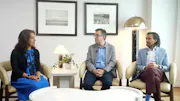
What does treating geographic atrophy earlier actually look like in practice? Moderator Geeta Lalwani, MD, and panelists Murtaza Adam, MD, and Carl Danzig, MD, weigh how factors such as fellow-eye status, lesion growth over time, and patient age shape their treatment decisions in patients with early GA, and they make the case for why dosing interval and patient motivation matter just as much as imaging biomarkers.
Posted: 7/01/2026
Geeta Lalwani, MD; Murtaza Adam, MD; and Carl Danzig, MD
What does treating geographic atrophy earlier actually look like in practice? Moderator Geeta Lalwani, MD, and panelists Murtaza Adam, MD, and Carl Danzig, MD, weigh how factors such as fellow-eye status, lesion growth over time, and patient age shape their treatment decisions in patients with early GA, and they make the case for why dosing interval and patient motivation matter just as much as imaging biomarkers.
Posted: 7/01/2026
Read Transcript
Geeta Lalwani, MD:
Hi, my name is Geeta Lalwani and we're going to get into a discussion now on treating patients earlier who have geographic atrophy. Carl, what are your thoughts on this? How has your practice changed in terms of complement inhibition from say 2023 when these drugs were first released to 2026?
Carl Danzig, MD:
So great question here, Geeta. Since 2023, which is a landmark year, we have two products that were FDA approved. Before that there was nothing and now patients have hope that we can slow the progression of the disease and hopefully preserve their vision longer. I am comfortable treating patients earlier in the disease process, patients with good vision, extrafoveal lesions, but I also look at the fellow eye, what does that show? Are they monocular? Are they not? Does the other eye have any GA? I look at risk factors. I also think if I see a patient that maybe it's a small lesion and they couldn't get into any of the trials, the products they're approved now, or even any of the current trials which we're in, I might say that's a patient we can wait and watch a little bit longer, but not just they come back in a year.
Maybe we'll bring that patient back in four to six months and just keep watching them closely.
Geeta Lalwani, MD:
Sure. And what about you, Moo? Do you treat earlier if patients meet the clinical trial inclusion criteria and have risk factors for progression?
Murtaza Adam, MD:
Well, I have to remember that there's a clear distinction between the real world and clinical trial patients. When a clinical trial is designed, there's a goal to prove efficacy, but there's also a goal to prove that efficacy within a certain timeline. I think that's why a lot of the studies had a mandatory GA lesion proximity to the fovea of 1500 microns or less. And so patients that have GA outside of that area still have risk for progression. And so although I think that's a great initial guideline to sort of steer your initial thoughts on treatment, it's a guideline nonetheless. And I use that to say, you know what? Maybe you're outside of the guidelines, but given your profile, your age, your other risk factors, smoking, fellow eye, all that plays a role in my decision making. And I think as time's gone on, my treatment of patients that had juxtafoveal lesions or foveal involving lesions and they're losing vision has evolved to seeing patients that have extrafoveal lesions that are demonstrably growing over time or patients have lost vision in their other eye.
And we're treating more aggressively. Again, I don't think this is the end all be all. We're grateful for these medications, but we just are buying time until the next generation of drugs comes to market.
Geeta Lalwani, MD:
So I think you make great points, both of you, that really the complexity of the patient in so many aspects, what the fellow eye looks like, what their overall risk factors look like, what their healthcare access looks like really plays a role into this. What about your dosing regimen? Do you change that based on your patient, Carl?
Carl Danzig, MD:
So starting treatment relies on the whole constellation of everything you described and patient motivation. So I try to motivate the patient to have monthly treatment initially and say, this is the label. Monthly treatment's great for ACP, for pegcetacoplans monthly or every other month. But in the end, if you start off, in my experience with patients who are needle averse, no one's raising their hand for more injections. I get it. So if you start off at every other month, can you go back to monthly? Almost never.
Geeta Lalwani, MD:
Yeah, that's a good point. That's actually a good point for patient adherence and understanding sort of the evolution of what's to come. So Moo, you alluded to this. What about a patient with a small unifocal lesion, but with banded characteristics outside the fovea, maybe outside 1500, unilateral? How do you talk to them about this?
Murtaza Adam, MD:
I try to highlight to them that they are at risk of vision loss in the next few years. The data is pretty clear on that from our natural history studies, from our control arms of our clinical trials. And I never ever push for treatment the same day the first time I see a patient. It's a lot to digest, a lot to swallow. But I think by showing photos at a baseline, showing photos at a follow-up four to six months later, even if there's minimal change, if there is change that you can see, which we have to remember and gather one and gather too, we saw a six month differential in patients in the control arm versus treatment arm. So even at six months, we're seeing GA growth. We're seeing a differential in patients that have GA growth that are treated. And so it's a nice way to highlight to the patient that I'm not just talking about every patient in the clinical trial, I'm talking about you.
We are seeing progression in you. And so now it's time to really consider doing something rather than nothing.
Geeta Lalwani, MD:
Sure. And the extension studies of both of these drugs, both Syfovre and Izervay have shown that there's a compounded effect. The longer you use it, the more you reduce the rate of progression.That I think is very important for patients to hear that once we get started, things are going to get better and better in terms of our ability to slow down the rate of progression of geographic atrophy.
Murtaza Adam, MD:
It's such a good point. I always tell my patients, it's kind of like if you had taken that piggy bank when you were a kid and put in $10 every week in that piggy bank since you were a child, you'd be a multimillionaire by now, right? Compound interest pays off. So the earlier you start, the more payoff you get in the long run.
Geeta Lalwani, MD:
So another thing I want to bring up is age. Initially, I have to admit when I first started, I said, "You know what? This meant for patients who are maybe in their 60s, 70s, 80s." But I have a few 90-year-old patients that are super active and want to preserve their vision. And so I have found myself changing that I treat patients who seem like they are more motivated and have a lifestyle that allows them to come into my clinic. What about you guys?
Carl Danzig, MD:
So I live in Florida so we have a - So
Geeta Lalwani, MD:
Everybody's ninety years old.
Carl Danzig, MD:
In terms of the bell curve of age, these are patients that they make it to their upper 80s and they're healthy and they're active and they're enjoying the nice weather and the activities. And even a patient of mine moved to Boulder and you know how active she is as a tango dancer with GA. And she's what, 89 now? So I agree with you. I one time had a patient who was 97 and I wanted to put her in clinical trial. This was before any of stuff was approved. And she's like, 97, how could I be in a trial? Who knows? And then I would see her, she's 105 and she has worse GA and she's like, "Maybe it should have been your trial." Or maybe I should have had treatment is really where it goes.
Geeta Lalwani, MD:
Sure
Murtaza Adam, MD:
Age is a number.
Geeta Lalwani, MD:
Wish we had gotten to her when she was 87 as opposed to 97. The earlier we get to the patients, the more we can slow it down.





![[2019] Amniotic Membrane Placement for Repair of Recurrent Macular Hole](https://d33x7gwyb2b5z6.cloudfront.net/eyetube/thumbs/gldaw.jpg?auto=compress,format&w=504)



Please log in to leave a comment.