


Search
Search
VBS: 2026

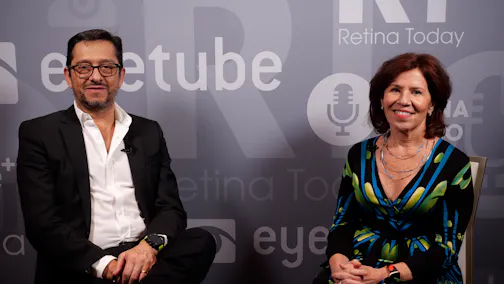
Samir N. Patel, MD and Maria H. Berrocal, MD
Show Description +
Drs. Patel and Berrocal sumaraize their lively debate about managing endophthalmitis. Dr. Patel argued for tap-and-inject, Dr. Berrocal was for immediate vitrectomy.
Posted: 4/15/2026
Samir N. Patel, MD and Maria H. Berrocal, MD
Drs. Patel and Berrocal sumaraize their lively debate about managing endophthalmitis. Dr. Patel argued for tap-and-inject, Dr. Berrocal was for immediate vitrectomy.
Posted: 4/15/2026
Read Transcript
Maria H. Berrocal, MD:
Hi, I'm Maria Berrocal.
Samir N. Patel, MD:
And I'm Samir Patel.
Maria H. Berrocal, MD:
And we were just debating here at the VBS 2026 meeting on the ideal treatment for endophthalmitis. And Dr. Patel was the winner. He was advocating for tap-and-inject as the ideal treatment modality. And I was advocating for early vitrectomy.
So Dr. Patel, tell us a little bit about your rationale as to why tap-and-inject is the ideal.
Samir N. Patel, MD:
I think we've formed our basis for vitrectomy for endophthalmitis based on the EVS, like you mentioned. That was done in 1995. And now our access to the OR continues to decline. We're not really in hospitals anymore. We're operating out of ASCs and just access to the OR has declined. And more recently, we found that tap-and-inject just with the antibiotics alone can have similar visual outcomes.
But you mentioned in your presentation that some of those outcomes aren't great and access to those locations can be difficult as well. But for the areas that we do have the access, I think tap-and-inject is a very reasonable early strategy.
Maria H. Berrocal, MD:
Yes. I have to say that I actually agree with you. We're not going to take everybody to the OR, but I was mentioning the Japanese studies in which what they do is they immediately, as soon as they see the patients, they inject a low concentration of povidone-iodine, which basically sterilizes the vitreous and kills everything, fungus, viruses. And then they take the patients to the operating room because that's a protocol there.
So I think in a sense, we have to think of novel ways of treating these patients because if you have access to a big city or you have access to a good training program, these patients get treated very quickly. But if it's someone that maybe had a cataract surgery 500 miles from the nearest, then many of those eyes are lost.
Vitrectomy does offer the benefits of clearing the media and all that. But I think considering that the way we've been treating this is 30, 50 years old data, and we haven't had really any good studies since then, I think we really have to start thinking a little bit outside of the box to see how can we salvage more eyes.
Samir N. Patel, MD:
I agree with you. I think our current paradigm is unfortunately antiquated and the type of endophthalmitis that we're seeing now is very different. And when EVS was around, that was mainly post-cataract surgery endophthalmitis. But now we have post-injection, post-vitrectomy, post-glaucoma. We're doing more and more surgery and we're unfortunately getting more and more endophthalmitis. And the variations of how we treat those different approaches is unique as well.
I think one of the things that could be of interest down the road is if we develop the advent of in-office OR, that could really cut that time and improve the availability of potential earlier treatment for endophthalmitis through even a surgical approach.
Maria H. Berrocal, MD:
Yeah, that is very interesting because years ago there was something called an intrector, which was a little portable machine, which was the cutter just pierced into the eye so that you could remove some of the vitreous, get a really good sample and clear part of it. And it was used a lot in Europe, but precisely for that to have like a quick in-office type vitrectomy to increase yields, sample yields and that.
But the organisms we're seeing are different. I think endogenous endophthalmitis is very different to filtering endophthalmitis, which is very different to intravitreal endophthalmitis is much milder even though we're seeing ...
Samir N. Patel, MD:
Definitely.
Maria H. Berrocal, MD:
That's what we see the most now because really the bacterial load is much smaller. But I think some preventive modalities have been really important. Like now people are irrigating with povidone during cataract surgery, even during the surgery. And then the bacteria that we see in all these cases, if you culture them at the end of the procedure, you see bacteria, we're reducing those loads.
So I think we have to think about preventive ways of avoiding this devastating complication.
Samir N. Patel, MD:
I agree. And I think your point at the end of the presentation was well taken in terms of having better studies to evaluate this. It's unfortunately very difficult to study this. As of now, it's so difficult to get good level one evidence for the management of this condition. And I don't know if we'll ever be able to get it except for outside of retrospective case studies or large database reviews, but it's really important to push the field forward in this manner 'cause this is really a visually devastating disease if not treated properly.
Maria H. Berrocal, MD:
Yes.
Well, thank you so much. I think it's been wonderful having this debate and I again congratulate you and ...
Samir N. Patel, MD:
I think it was a very close debate, near 50-50.
Maria H. Berrocal, MD:
No, no, no. It was 51-49. But thank you everyone.
Samir N. Patel, MD:
Thank you.
Bryn Mawr Communications, LLC, and Eyetube.net are not affiliated with the official program of VBS: 2026.















Please log in to leave a comment.