


Search
Search
Watch 3D videos on your phone.
Show Description +
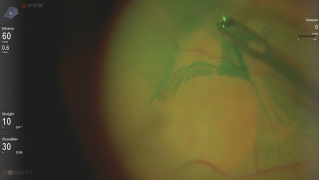
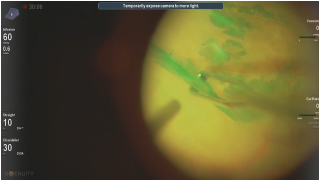
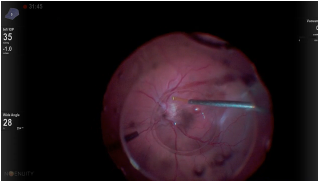
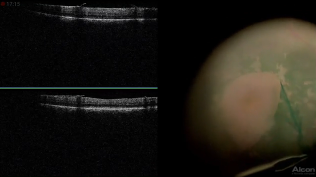
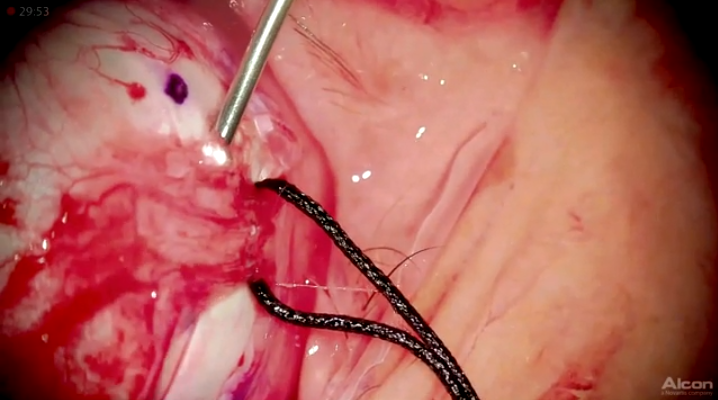
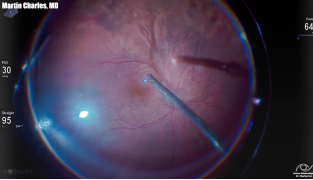
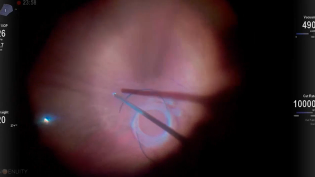
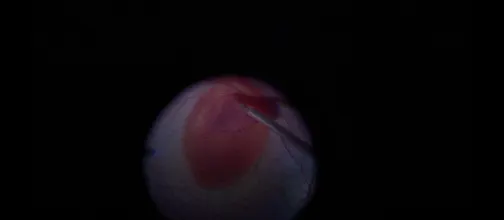
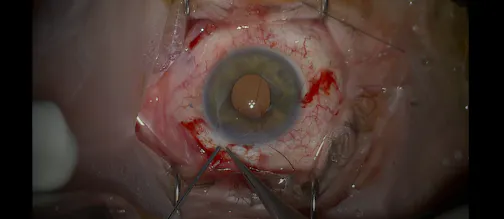
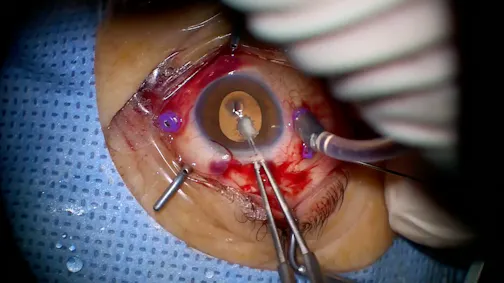
Maria H. Berrocal, MD, presents a case of a 71-year-old male with insulin-dependent diabetes mellitus who presented with an inferotemporal tractional and rhegmatogenous retinal detachment involving the fovea. VA was 20/400. The patient underwent a pars plana vitrectomy using the 3D NGENUITY Visualization System (Alcon) and 27-gauge beveled 10,000 cuts-per-minute vitrectomy probe on the Constellation (Alcon) vitrectomy platform. All the membranes and fibrovascular tissue causing traction in the periphery were dissected with the probe, and an epiretinal membrane over the posterior pole was peeled with the FINESSE Sharkskin Forceps (Alcon). Diathermy was applied to vessels and areas of neovascularization in the detached retina. A fluid-air exchange was performed with aspiration with the vitrectomy probe through the peripheral break. A Vektor illuminated directional laser (Alcon) was used to apply laser around the edges of the break and to areas of neovascularization. A gas tamponade was utilized. Postoperatively, the patient's retina is attached, and uncorrected VA is 20/200.
Posted: 11/20/2018
Maria H. Berrocal, MD, presents a case of a 71-year-old male with insulin-dependent diabetes mellitus who presented with an inferotemporal tractional and rhegmatogenous retinal detachment involving the fovea. VA was 20/400. The patient underwent a pars plana vitrectomy using the 3D NGENUITY Visualization System (Alcon) and 27-gauge beveled 10,000 cuts-per-minute vitrectomy probe on the Constellation (Alcon) vitrectomy platform. All the membranes and fibrovascular tissue causing traction in the periphery were dissected with the probe, and an epiretinal membrane over the posterior pole was peeled with the FINESSE Sharkskin Forceps (Alcon). Diathermy was applied to vessels and areas of neovascularization in the detached retina. A fluid-air exchange was performed with aspiration with the vitrectomy probe through the peripheral break. A Vektor illuminated directional laser (Alcon) was used to apply laser around the edges of the break and to areas of neovascularization. A gas tamponade was utilized. Postoperatively, the patient's retina is attached, and uncorrected VA is 20/200.
Posted: 11/20/2018


![Glaukos iStent Inject [3-D]](https://d33x7gwyb2b5z6.cloudfront.net/eyetube/thumbs/jgpiy.jpg?auto=compress,format&w=180)

Please log in to leave a comment.